
If you are interested in natural remedies for hot flashes and night sweats – this material is for you. Here…
If you are interested in natural remedies for hot flashes and night sweats – this material is for you.
Here we'll talk about effective, research-proven natural remedies such as herbal teas and supplements and various lifestyle changes that help to stop hot flashes fast.
Hot flashes are one of the most common symptoms menopausal women experience. They occur unexpectedly – like a sudden wave of heat spreading over the upper body, with redness of the skin and sweating.
“Around 75% of women experience hot flashes during menopause, and for 20% of them, the symptoms are severe.”– North American Menopause Society (NAMS)
These hot flashes disrupt sleep, affect daily activities, and create awkward moments in public places.
Although they are a natural part of menopause caused by hormonal shifts, many of us seek relief from their intensity and frequency. And many looking for help without hormones.
While hormone replacement therapy is an option for some, it is not suitable for everyone due to possible side effects or health concerns.
This is why we seek natural, effective and hormone-free remedies that help reduce hot flashes during perimenopause and menopause.
What Causes Hot Flashes?
Menopausal hot flashes and night sweats are caused by changes in the body's hormonal balance: due to decreased levels of estrogen and progesterone and increased levels of the stress hormone cortisol. This hormonal dance often makes certain brain structures responsible for thermoregulation hypersensitive.
The hypothalamus, the part of the brain responsible for controlling body temperature, becomes more sensitive to minor temperature shifts, and to other impulses that result from hormonal fluctuations.
This excitation of the thermoregulation centre we feel as a hot flush. Bursts or sudden decreases in what particular hormone causes these hot flashes? It could be estrogen, cortisol or even insulin.
That's why hormone replacement therapy doesn't always work. If your hypothalamus is overly sensitive, you're taking hormones but ignoring factors like stress and diet – the hot flashes will continue.
High-stress releases cortisol, which can increase the frequency and intensity of hot flashes.
Certain foods and drinks – especially spicy foods, caffeine and alcohol – can cause blood vessels to dilate, leading to the familiar hot flashes.
If you begin to address these triggers through lifestyle adjustments, you may find relief in reducing the intensity and frequency of hot flashes.
Lifestyle Changes to Manage Hot Flashes Naturally
Adjust your diet
We now know that spicy foods, caffeine and alcohol, trigger hot flashes in many women by raising body temperature and dilating blood vessels.
Cutting back on these foods will help reduce the likelihood of hot flashes.
Instead, incorporate cooling, nutrient-rich foods such as leafy greens, cucumbers, lemons, coconut and soy products, and flaxseed.
Leafy greens like spinach and kale are rich in antioxidants and fibre that support overall health, and soy-based products contain phytoestrogens, plant compounds that can help balance estrogen levels. Coconut milk and oil contain electrolytes such as potassium that help maintain fluid balance and according to Ayurveda, coconut milk has a cooling effect on the body.
Flaxseeds are another source of energy, containing both omega-3 fatty acids and phytoestrogen precursors that not only help cool the body from the inside out but also support a healthy microbiota.
Techniques for the body and mind
There is strong evidence from clinical studies that using psychological practices such as CBT (cognitive behavioural therapy), MBSR (mindfulness-based stress reduction), and hypnotherapies can help calm the mind and body and significantly reduce the frequency and severity of hot flashes (source).
“Incorporating mindfulness and deep-breathing exercises can significantly reduce the intensity and frequency of hot flashes in menopausal women.” – Harvard Health Publishing
This further proves that hot flashes originate not so much from lessening estrogen but rather from the stress hormone cortisol, the levels of which are elevated in most women in the pre-and post-menopausal periods (source).
Deep breathing exercises can reduce stress levels and bring immediate relief during a hot flush. Simply slowing down and focusing on deep, rhythmic breathing can help restore the body's stress response.
Yoga and mindfulness-based meditation also provide long-term benefits by lowering cortisol levels and promoting relaxation, making the body less reactive to triggers of flare-ups.
Even acupuncture has been recognized for its potential to alleviate hot flashes and related symptoms; studies show that acupuncture can help regulate body temperature and maintain hormonal balance.
These natural methods not only help to manage hot flashes but also improve your overall health, making them a great addition to your menopause self-care routine.
Effective herbal remedies for hot flashes
- Black cohosh
Black cohosh is one of the most studied and popular herbal remedies known for its potential to alleviate menopausal symptoms, especially hot flashes (source).
“Black cohosh has shown effectiveness in reducing hot flashes in 40-50% of women in studies lasting up to 6 months.” – Cochrane Review
Derived from the root of the North American plant the extract acts on serotonin receptors that play a role in regulating body temperature.
Black cohosh does not contain estrogen, but it can mimic some estrogenic effects in the body, helping to alleviate the intensity and frequency of hot flashes.
Taking standardized capsules or tablets provides a consistent dosage.
The recommended dose is 20 to 40 mg twice daily before or after meals. Although taking on an empty stomach may result in a faster onset of effects, black cohosh may cause feelings of nausea.
- Sage
Sage is another well-known herbal remedy for combating hot flashes (source).
Traditionally used to treat a variety of menopausal symptoms, sage helps regulate the nervous system, which can ease fluctuations in body temperature.
Sage can be drunk as a tea by steeping a few fresh or dried leaves in hot water or taken in supplement form, with a typical dosage of 300-400 mg per day. According to research results, it might take up to 8 weeks of taking sage before sage will help manage hot flashes.
Sage also supports memory and cognitive health, which is an added benefit for women going through menopause.
However, in high doses, it can cause mild side effects such as dry mouth or, in rare cases, nausea. In addition, because sage contains compounds that may act similarly to estrogen, women with estrogen sensitivity should consult a physician before using sage as a medicine.
- Isoflavones
Soy and red clover isoflavones (also known as phytoestrogens) are popular natural remedies for combating hot flashes during menopause (source). Isoflavones are thought to mimic the effects of estrogen in the body, alleviating menopause symptoms.
Research also shows that soy isoflavones have stronger evidence for their effectiveness than red clover.
- Soy isoflavones
Soy isoflavones can reduce the frequency and severity of hot flashes, which is supported by numerous studies (sources 1, 2, 3).
A meta-analysis of clinical trials published in the journal Menopause showed that soy isoflavones significantly reduced the frequency of hot flashes, and in some studies by 26-56% compared to the placebo group (source).
The effective dose of soy isoflavones for reducing hot flashes is typically between 30 mg and 200 mg per day. Supplements typically use an average daily dose of about 100 mg, which may result in a 30.5% reduction in the frequency and severity of hot flashes (source).
Soy isoflavones and soy products in general are worth being careful with if you have a family history of breast cancer.
- Red clover
Red clover also contains phytoestrogens, mostly in the form of isoflavones, but the evidence for its effectiveness is less convincing.
A systematic review published in the journal Climacteric noted that while some women report benefits from taking red clover, the overall effect is smaller and less sustained than with soy isoflavones (source).
Studies suggest that red clover may be more effective for women with mild to moderate symptoms rather than severe hot flashes.
Red clover is usually taken as a tea, tincture, or capsule, with doses typically ranging from 40 to 80 mg of isoflavones per day.
Although it is generally considered safe, women with hormone-dependent conditions should consult a doctor before consuming red clover, as its estrogen-like properties may not be suitable for everyone.
- Vitex
There are few studies investigating the effects of Vitex (Vitex agnus-castus) on hot flashes. One notable study examined a combination of Vitex, magnolia extracts, and isoflavones – throughout the year-long study, this combination significantly alleviates vasomotor symptoms, including hot flashes (source).
Vitex was found to reduce the intensity of hot flashes, so it is recommended to combine it with other supplements such as herbs, evening primrose oil or others which we will discuss below.
Read here for more about supplements that help to go through menopause.
DIY Recipe: Herbal tea to ease hot flashes
Sage, red clover, and chamomile soothing tea.
A soothing herbal tea that combines sage, red clover, and chamomile can bring mild relief from hot flashes while promoting relaxation. Not only does it provide relief, but it creates a peaceful, calming ritual that is ideal for soothing the mind and body during menopause.
Recipe: 1 teaspoon of dried sage, 1 teaspoon of dried red clover flowers, and 1 teaspoon of dried chamomile flowers to make the tea.
Add the herbs to a teapot or tincture, pour in 8 ounces of hot (but not boiling) water, and let infuse for about 10 minutes. Strain the tea, sweeten it with honey if desired, and drink slowly.
This mixture can be drunk up to twice a day.
Licorice Root and Fennel Tea
Liquorice root contains a substance called glycyrrhizin that may help balance hormones, while fennel contains anethole and other phytoestrogens that have similar estrogenic properties and can reduce hot flashes.
Recipe: Add 1 teaspoon of dried liquorice root and 1 teaspoon of crushed fennel seeds to hot water and steep for 5-7 minutes. Strain and drink warm, but consult a healthcare provider before regular use, as liquorice root can affect blood pressure when taken long-term.
Lemon Balm and Lavender Tea
Both lemon balm and lavender help reduce stress and promote relaxation, which can lessen the frequency of hot flashes triggered by anxiety.
Recipe: 1 teaspoon each of dried lemon balm and lavender flowers, steep in hot water for 8-10 minutes, then strain. This fragrant tea is best enjoyed in the evening as a calming ritual.
Holy Basil (Tulsi) and Spearmint Tea
Holy basil, or tulsi, is an adaptogen that helps the body manage stress, while spearmint offers a refreshing, cooling effect.
Recipe: Combine 1 teaspoon of dried holy basil with 1 teaspoon of dried spearmint leaves, steep for 5-8 minutes, and drink warm or cool. This blend is ideal for daily use and pairs well with honey.
These teas offer a variety of supportive properties and can be adjusted to personal taste or enjoyed at different times of day, depending on the needs and preferences.
Other Supplements for Hot Flashes
- Vitamin E
Vitamin E, an antioxidant, has been studied for its potential to reduce the severity of hot flashes in menopausal women (source).
Some research suggests that Vitamin E can stabilize the body’s temperature regulation, helping to decrease the intensity of hot flashes when taken in moderate doses. In one study, participants who took 400 IU of Vitamin E daily reported experiencing milder hot flashes, though results can vary by individual (source). Vitamin E is generally safe, but it’s best to stay within recommended dosages and discuss with a healthcare provider to avoid interactions or excess, especially if taking other supplements or medications.
- Evening Primrose Oil
Evening primrose oil is a supplement derived from the seeds of the evening primrose plant, known for its gamma-linolenic acid (GLA) content, an omega-6 fatty acid thought to support hormonal balance (source).
For menopausal women, evening primrose oil may help reduce the frequency and intensity of hot flashes by easing inflammation and balancing hormonal shifts.
The typical dose ranges from 500 mg to 1,000 mg daily, although it may take a few weeks to notice the effects. While many women tolerate it well, mild side effects like stomach upset are possible, so it’s always wise to start with a lower dose and consult a healthcare provider before use, especially for those on medications.
My story
I have tried many different supplements to manage hot flashes and night sweats. Now I know they are provoked more by stress and not so much by estrogen loss.
I can't take hormone replacement therapy, so I had to turn to supplements for help. The women in my family have suffered from hot flashes and night sweats for 10 years or more: stories run in the family about my grandmother's sweat-rotted corset and my mom's leather watch strap. For me, it took 3 degrees to figure out my menopause symptoms – medical biophysics, nutrition and functional medicine, but in the end, I managed to find a formula that helped me out.
I take 2 tablespoons of ground flaxseed a day (you should know that you should start taking flaxseed gradually, with 1 teaspoon).
I also take supplements with black cohosh, red clover, vitex, Rhodiola rosea, lady's mantle (Alchemilla) and melissa.
I drink a soothing tea before bed and also try not to go to bed hungry: a drop in blood sugar can also trigger a cortisol release and night sweats, which can make it very difficult to fall asleep.
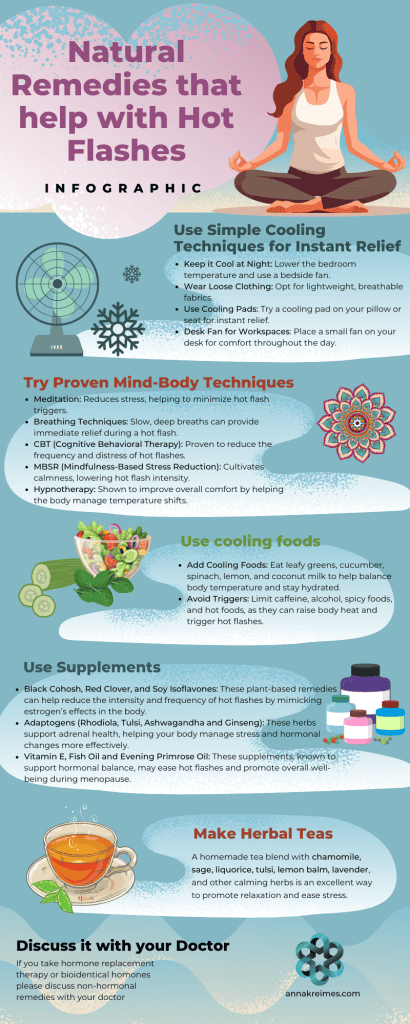
Here are 65 Proven Tips for Your Hormonal Balance During Menopause.
When to See a Doctor
You can combine natural remedies for hot flashes with medical methods.
For example, you may find that herbal supplements such as black cohosh or soy isoflavones help reduce symptoms, while your doctor may suggest hormone therapy or other medications for more significant relief.
However, some herbs might also interfere with medicines – so, please, discuss your options with your doctor.
While natural remedies can help reduce hot flashes, it is important to know if your hot flashes are severely interfering with your daily life, causing sleep disturbances or significant mood changes, it is worth consulting a medical professional.
If your hot flashes are accompanied by unusual symptoms such as heavy bleeding, persistent abdominal pain, or any new symptoms that bother you, don't hesitate to seek help.
This could be a warning sign indicating an underlying problem that requires medical evaluation.
Key takeaways
- Although hot flashes and night sweats are considered classic symptoms of menopause, the triggers for them are not so much a drop in estrogen but a change in the thermoregulation centre in the brain due to hormonal imbalance.
- The main hormonal trigger is the stress hormone cortisol and all other triggers that can provoke sudden dilation of blood vessels: stress, anxiety and fear, high indoor or outdoor temperatures, tight-fitting clothing, spicy hot food and drinks, alcohol, and coffee.
- There are many ways to manage hot flashes. Breathing practices and cognitive behavioural therapy show high results in reducing the intensity and frequency of hot flashes and night sweats because of their ability to reduce cortisol levels.
- Natural supplements are considered less effective than hormones, but together with psychological practices, they will effectively and most importantly safely relieve you of menopause symptoms and improve your physical and mental health and quality of life. Talk to your doctor to discuss available options.


